

 Deutsch
SLA
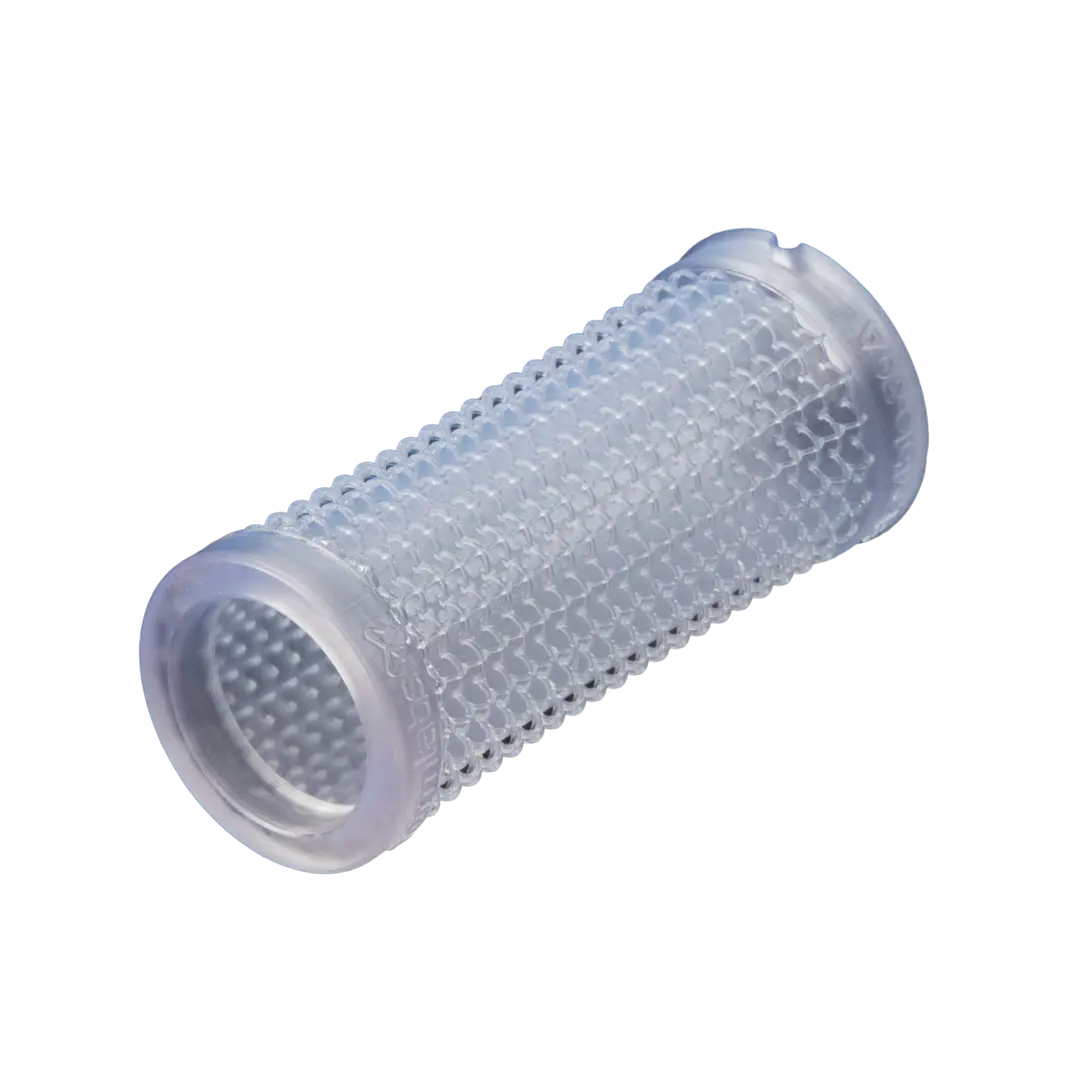
Formlabs Flexible 80A Resin is an elastic SLA resin for rubber-like functional prototypes. Version V1.1, documented in this catalogue, belongs to the translucent material generation and has a Shore hardness of 80A. It produces compliant parts with a feel reminiscent of harder rubber or TPU.
The material can be used to develop grip sleeves, protective pads, flexible holders and damping elements. Bending, compression and the handling of soft functional features can be explored with detailed printed parts. Geometry and wall thickness help determine whether an area feels firm, spring-like or easily deformable.
Wall thickness, support locations and post-curing are matched to the required deformation behaviour. Large solid areas feel noticeably firmer than thin features or hollow structures. The grade described here is V1.1; the matte black V2 is a different formulation with its own properties.
Material information: Formlabs · Formlabs · V1.1 data sheet
Application ideas
- Grip sleeves and contact pads
- Flexible holders and protective parts
- Damping and compression models
- Rubber-like functional prototypes
Properties and test conditions
| Property | Value / condition |
|---|---|
| Manufacturer / grade | Formlabs · Flexible 80A Resin V1.1 · Identity from input list; see PDF for version |
| Tensile strength | 6.4 MPa · ASTM D412-16, 500 mm/min; V1.1, Rev. 03, 2026-05-26; Form 4, 100 µm; IPA ≥99%, 20 min; Form Cure L V1: 10 min / 60 °C; testing after >3 h at 23 °C |
| Elongation at break | 130 % · ASTM D412-16; V1.1, Rev. 03, 2026-05-26; Form 4, 100 µm; IPA ≥99%, 20 min; Form Cure L V1: 10 min / 60 °C; testing after >3 h at 23 °C |
| Shore hardness | 80 A · ASTM 2240; V1.1, Rev. 03, 2026-05-26; Form 4, 100 µm; IPA ≥99%, 20 min; Form Cure L V1: 10 min / 60 °C; testing after >3 h at 23 °C |
Source review: 2026-10-03
Limitations and post-processing
Suitability depends on geometry, orientation, print profile and material condition. Drying, annealing, or washing and post-curing are material- and profile-specific. Material data do not certify a part.